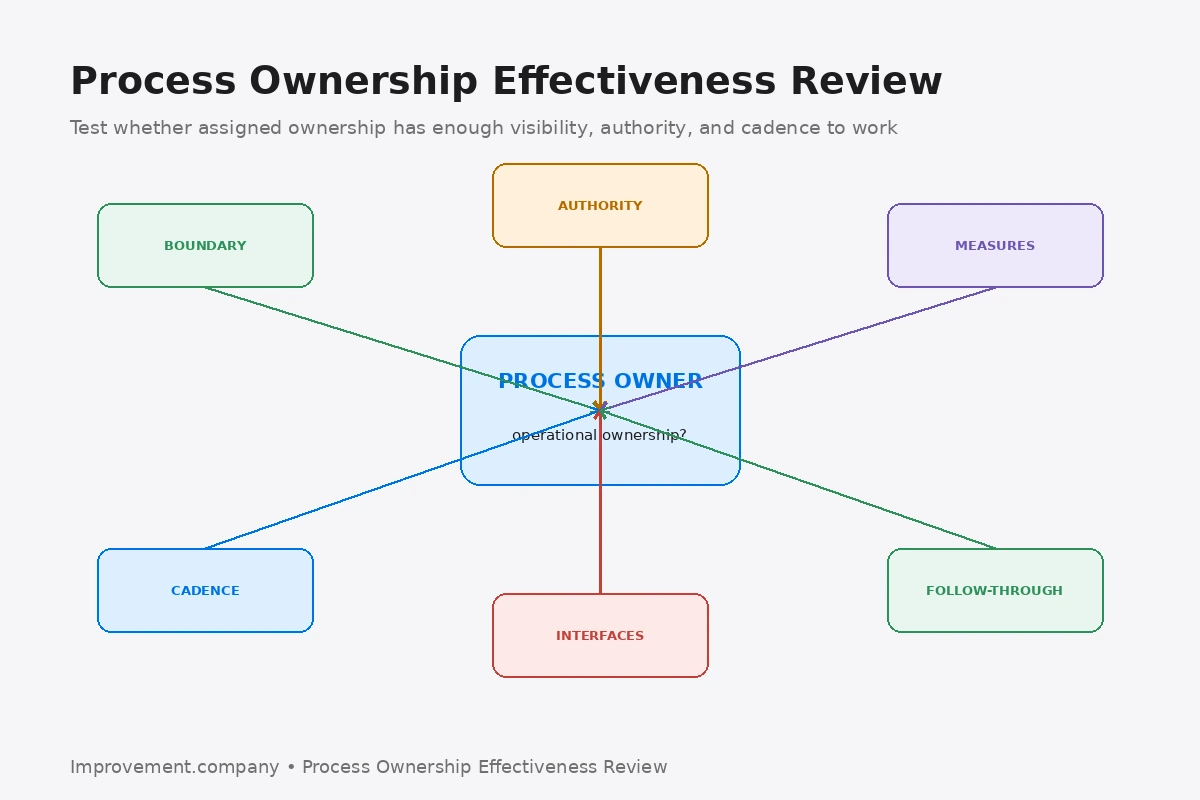
A Process Ownership Effectiveness Review checks whether assigned process ownership is producing real accountability and decision quality.
Naming a process owner is not enough.
The owner needs enough information, authority, and management routine to influence the process end to end.
Confirm the process boundary
Process Ownership helps define accountability for end-to-end performance.
Review whether the owner understands:
- where the process starts;
- where it ends;
- which customers and suppliers are involved;
- which functions participate.
Ambiguous boundaries create ambiguous ownership.
Review decision authority
Ask whether the owner can make or escalate important decisions about:
- process priorities;
- standards;
- controls;
- improvement needs.
Process Governance Review helps check ownership, decision rights, escalation paths, review cadence, control authority, and interfaces.
An owner without sufficient decision access may have accountability in name only.
Review measures
The owner should receive measures that show the health of the process.
Process KPI Hierarchy helps connect process indicators with higher-level outcomes.
Avoid giving the owner only functional metrics that hide end-to-end performance.
Review cadence
Ask whether the process owner has a regular forum for:
- performance;
- risk;
- decisions;
- follow-up.
Operating Review System helps establish how information and decisions move through management cadence.
Review cross-functional coordination
Process Interface Management helps clarify what one process must provide to another at functional boundaries.
The owner should be able to address handoff issues that fall between departments.
Review risk and control ownership
Significant process risks need clear monitoring and response.
Process Risk Review helps reassess risks, controls, triggers, assumptions, and ownership as conditions change.
Review improvement follow-through
The owner should be able to:
- sponsor needed improvement;
- sustain completed changes;
- close weak controls;
- escalate unresolved barriers.
Ownership is effective when it connects performance information with action.
Common mistakes
Assigning an owner with no authority, defining unclear process boundaries, measuring only functional performance, providing no regular review forum, leaving cross-functional issues to informal negotiation, separating risk ownership from process ownership, and using the title “process owner” without changing how decisions are made are common mistakes.
Practical sequence
- confirm the process boundary.
- confirm the named owner.
- review decision rights.
- review end-to-end measures.
- review management cadence.
- review cross-functional interfaces.
- review risk and control ownership.
- review improvement follow-through.
- identify ownership gaps.
- update governance where needed.
The practical lesson
A Process Ownership Effectiveness Review tests whether ownership is operational.
A process owner should have enough visibility, authority, and cadence to influence the performance they are expected to own.