
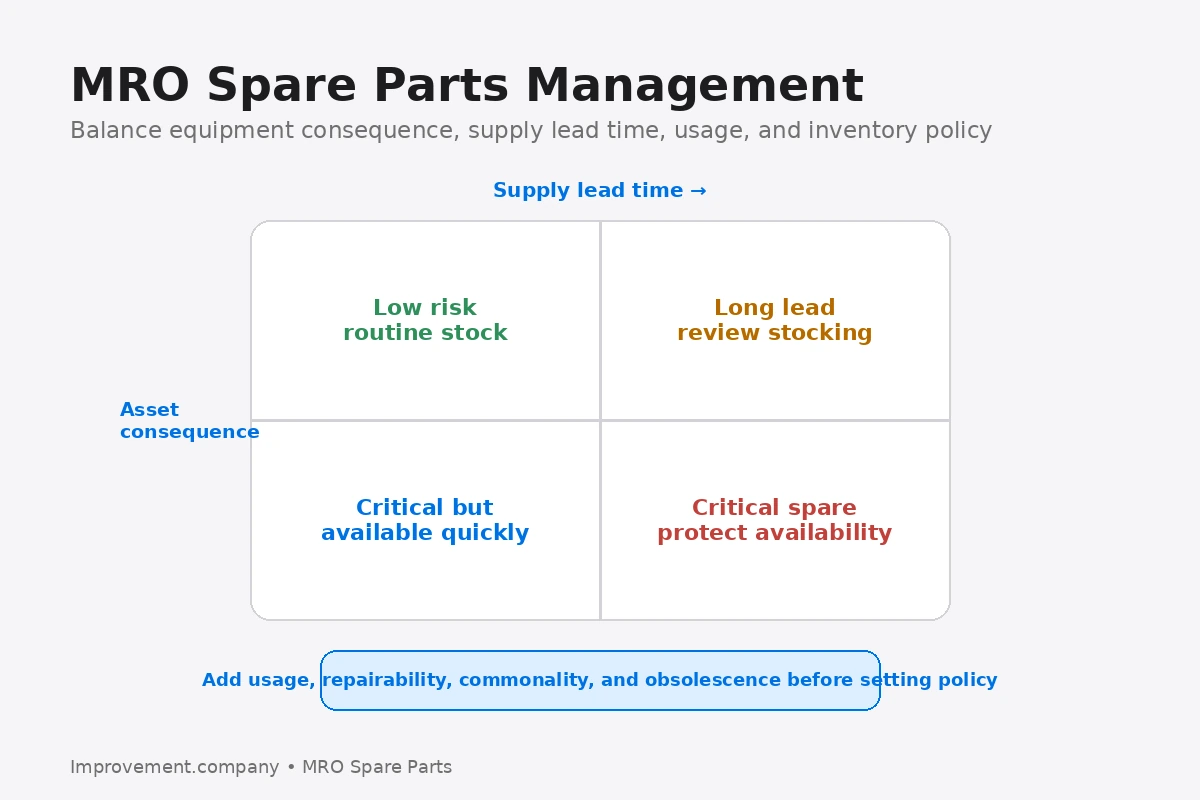
MRO Spare Parts Management is the discipline of deciding which maintenance, repair, and operating parts should be stocked, how much should be held, and how the inventory should be controlled.
The objective is not maximum inventory.
The objective is the right availability at an acceptable cost and risk.
Start with equipment consequence
A spare part is more important when its absence can create a serious operational consequence.
Questions include:
- What equipment uses the part?
- What happens if the part is unavailable?
- Is there redundancy?
- How long can the process tolerate the outage?
Asset Criticality Analysis helps prioritize equipment and therefore supports spare-parts decisions.
Consider supply lead time
A low-cost part with a six-month lead time may deserve more attention than an expensive part available locally in one hour.
Relevant supply factors include:
- supplier lead time;
- transportation;
- minimum order quantity;
- repair turnaround;
- supplier reliability;
- customs risk;
- obsolescence.
The stocking decision should reflect the full replenishment risk.
Understand demand pattern
MRO demand is often intermittent.
Some parts are used every week.
Others may not be used for years.
Historical usage is useful, but it should not be the only input.
A critical spare with zero historical demand may still be essential if the consequence of waiting for a replacement is severe.
Classify spares
A practical classification may consider:
- criticality;
- lead time;
- usage;
- value;
- repairability;
- commonality.
Examples include:
- insurance spares;
- critical operating spares;
- routine consumables;
- repairable components;
- nonstock items.
Classification makes stocking rules easier to manage.
Link parts to equipment
The inventory system should clearly show where each important part is used.
Useful relationships include:
- asset;
- equipment model;
- BOM;
- manufacturer;
- approved alternative;
- storage location.
Maintenance Planning and Scheduling becomes more reliable when planners can quickly determine whether required parts are available before work is scheduled.
Control inventory accuracy
A part that exists in the computer but not on the shelf is not available.
Good controls may include:
- controlled issue;
- cycle counting;
- clear locations;
- labeling;
- reservation rules;
- reorder parameters.
The store should support maintenance execution rather than become a hidden source of delay.
Manage repairable spares
Some expensive components are repaired and returned to stock.
Examples include:
- motors;
- gearboxes;
- drives;
- pumps;
- electronic boards.
The organization should track:
- failed unit;
- repair status;
- repair quality;
- turnaround time;
- available serviceable quantity.
Repeated repair failures may require reliability investigation.
Review obsolete and duplicate stock
MRO inventories often accumulate:
- parts for retired equipment;
- duplicated descriptions;
- superseded components;
- unidentified stock.
Periodic review can release working capital and storage space without increasing risk.
Early Equipment Management can reduce future spare-parts complexity by considering standardization and maintainability during equipment selection.
Use critical spares in shutdown planning
Major maintenance events should identify required critical parts well before execution.
Shutdown and Turnaround Planning depends on prepared material, kits, tools, and contingencies.
A missing critical part during a shutdown can extend the entire outage.
Common mistakes
Stocking based only on purchase price, using historical demand without considering consequence, keeping parts with no asset relationship, failing to control inventory accuracy, ignoring repair turnaround, and carrying obsolete material indefinitely are common mistakes.
Practical sequence
- identify the equipment supported.
- assess equipment consequence.
- review supplier lead time.
- analyze demand pattern.
- classify the spare.
- define stocking policy.
- link the part to assets and BOMs.
- maintain inventory accuracy.
- manage repairable spares.
- periodically review obsolescence and stocking logic.
The practical lesson
MRO inventory is a reliability decision, not only a purchasing decision.
The best system protects critical equipment while avoiding inventory that no longer reduces meaningful risk.