
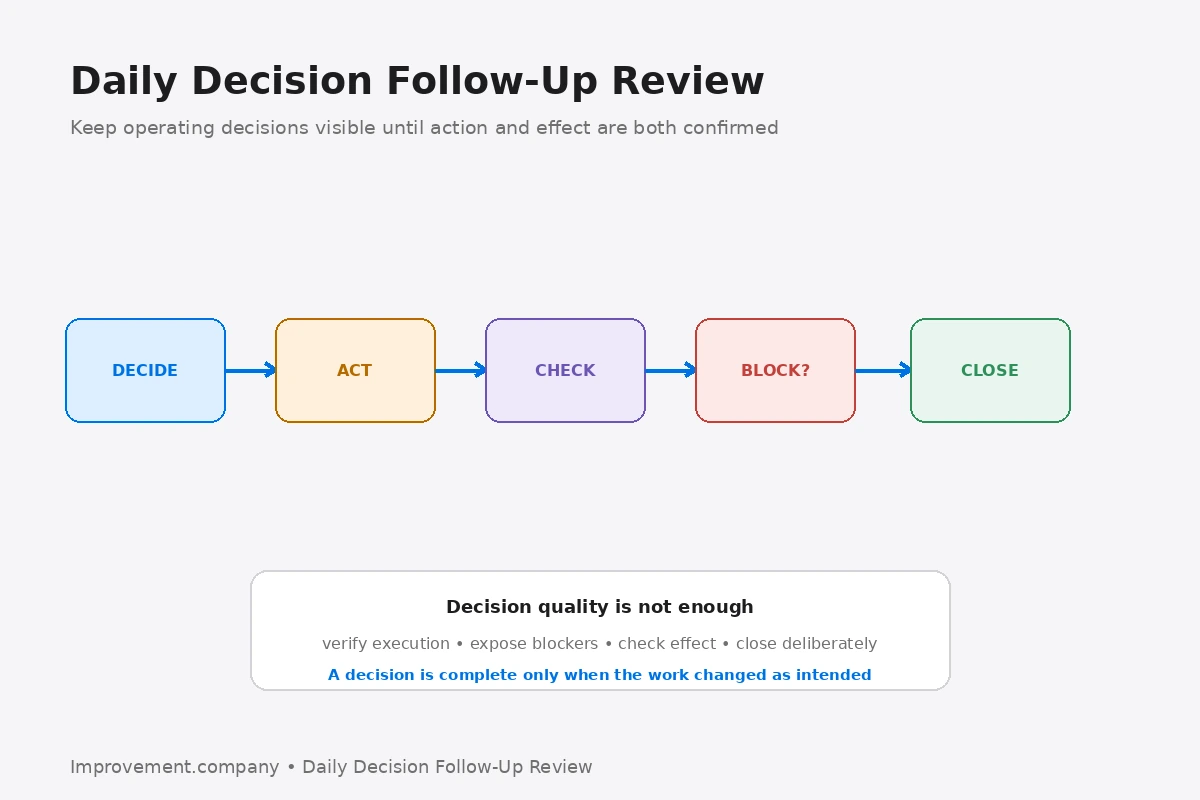
A Daily Decision Follow-Up Review checks whether important decisions made in the operating management system were actually executed and produced the intended effect.
Daily meetings can make fast decisions.
The risk is that the decision disappears once the meeting ends.
Identify decisions worth following
Not every routine choice needs formal tracking.
Focus on decisions that affect:
- safety;
- quality;
- customer service;
- production priorities;
- recovery;
- resource allocation.
Daily Accountability Process helps connect commitments with owners, due timing, and follow-up.
Record the decision clearly
Capture:
- what was decided;
- who owns the next action;
- when it should occur;
- what result is expected.
A statement such as “maintenance will look at it” is too vague.
Check execution
At the next appropriate review, ask:
- Was the action completed?
- Was the required support delivered?
- Did the operating condition change?
Leader Follow-Up Discipline helps make commitments reliable through ownership, timing, evidence, escalation, and closure.
Review blockers
If the decision was not executed, identify why.
Typical blockers include:
- missing authority;
- unavailable specialist;
- material delay;
- conflicting priority.
Daily Priority Conflict Review helps resolve competing demands before work stalls.
The review should expose the blocker rather than repeatedly moving the due time.
Check the effect
A decision can be implemented and still fail.
Examples include:
- overtime approved but output did not recover;
- inspection added but escapes continued;
- schedule changed but the constraint still starved.
Daily Response Effectiveness Review helps distinguish activity from an operating response that actually controls the condition.
Close or reopen
Close the decision when:
- action occurred;
- expected effect was checked;
- no unresolved risk remains.
Reopen or escalate when the result is insufficient.
Review repeated decision failure
If similar decisions repeatedly fail, investigate the management system.
Possible causes include:
- weak authority;
- poor information;
- slow support;
- unclear ownership.
Process Decision Log can preserve important decisions and their logic when the consequence extends beyond the daily cycle.
Common mistakes
Tracking every minor choice, recording no expected effect, closing decisions when an action is completed but the condition remains, repeatedly changing dates without escalation, losing decisions between management tiers, and blaming execution when the original decision was weak are common mistakes.
Practical sequence
- identify significant decisions.
- record the decision clearly.
- assign one action owner.
- define timing.
- define the expected effect.
- review execution.
- expose blockers.
- verify the operating result.
- close, reopen, or escalate.
- review repeated decision failures.
The practical lesson
A Daily Decision Follow-Up Review turns meeting decisions into operating results.
A decision is not complete when it is announced; it is complete when the required action occurs and the effect is understood.