
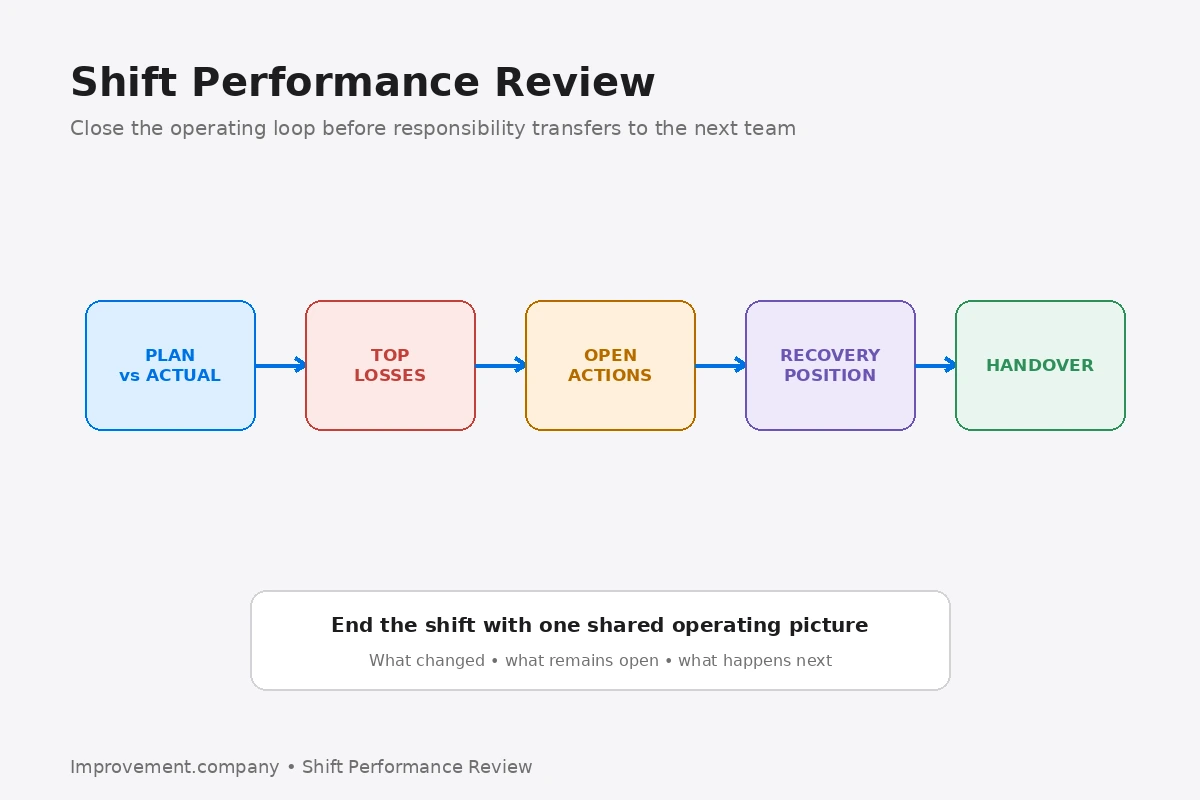
A Shift Performance Review is a short end-of-shift routine used to compare the operating plan with actual performance before responsibility transfers to the next team.
The objective is not to create a long report. The objective is to close the operating loop: what was expected, what actually happened, what remains unresolved, and what the next shift must know.
Start with plan versus actual
Review the few measures that define the shift’s expected result, such as output, schedule attainment, quality, downtime, staffing, and safety abnormalities.
Schedule Attainment helps compare what was completed with what the schedule required.
The review should focus on meaningful gaps rather than reading every number on the board.
Explain the largest losses
Identify the few losses that materially affected the result.
Daily Loss Review helps convert lost time, output, or capacity into prioritized operating information.
Ask what happened, how much it affected the shift, whether the issue is contained, and whether it is likely to recur.
Do not accept vague explanations such as “machine issues” when the loss can be stated more precisely.
Review open actions
Each significant gap should have a visible response.
Action Closure Criteria helps define what evidence is required before an action can be considered complete.
Separate actions completed, actions still open, and actions requiring escalation.
Update the recovery position
If the daily commitment remains at risk, update the remaining gap and expected recovery.
Shift Recovery Handover helps transfer unresolved performance gaps, owners, risks, and next triggers without resetting the problem.
The incoming team should inherit the current recovery position, not outdated information.
Identify repeat problems
A repeated loss may need more than another daily action.
Possible escalation paths include maintenance analysis, formal problem solving, process change, or supplier action.
Problem-Solving Review Cadence helps keep deeper investigations moving after the immediate shift response is complete.
Keep the review short
A practical review may take 10 to 15 minutes when the underlying daily-management system is current.
If the team must reconstruct the entire shift from memory, the problem is usually weak real-time management rather than the review itself.
Common mistakes
Reviewing every metric equally, accepting vague loss explanations, carrying open actions without owners, closing actions without evidence, restarting unresolved problems on the next shift, and turning the review into a presentation are common mistakes.
Practical sequence
- compare plan versus actual.
- identify the largest gaps.
- quantify major losses.
- review completed actions.
- review open actions and owners.
- update the recovery forecast.
- identify repeat issues.
- define required escalation.
- prepare the handover.
- close the shift with one shared operating picture.
The practical lesson
A Shift Performance Review converts the completed shift into usable information for the next one.
Good handover starts with a disciplined review of what changed, what remains open, and what must happen next.