
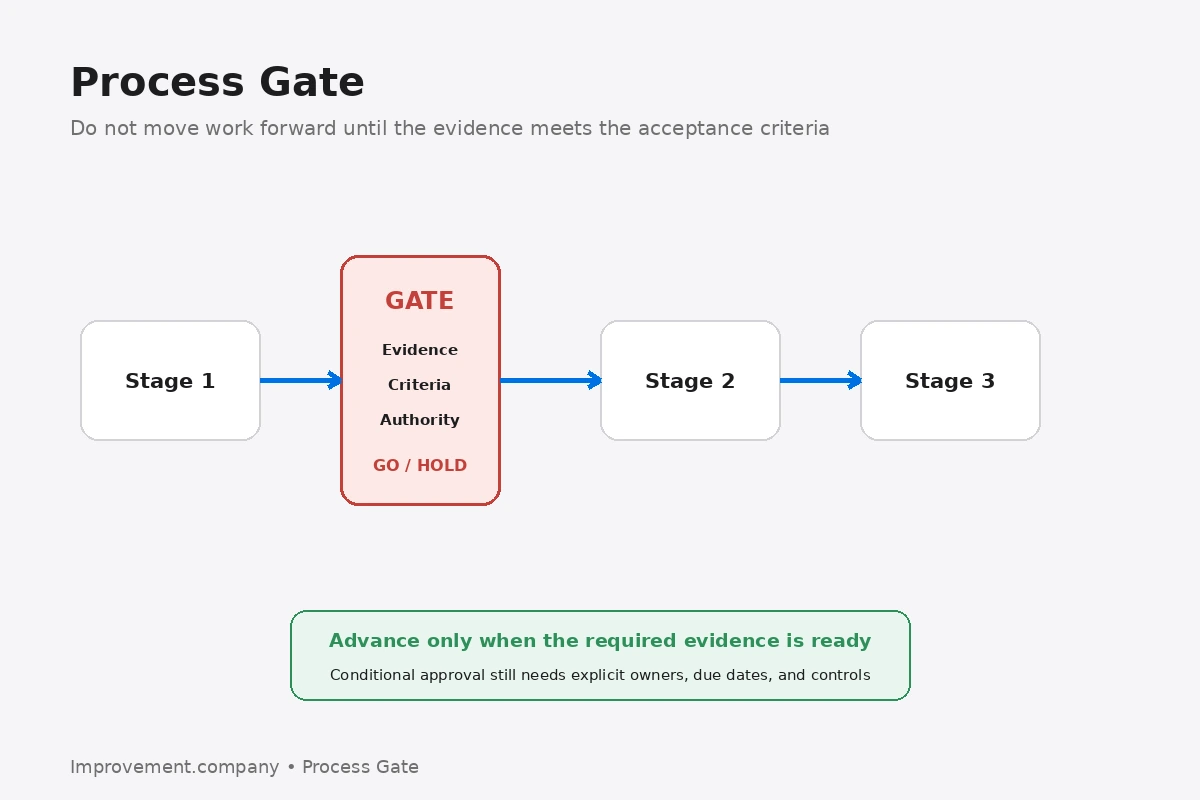
A Process Gate is a defined decision point that prevents work from moving to the next stage until required conditions are satisfied.
Examples include design release, supplier approval, production launch, project funding, and customer handoff.
The objective is to stop incomplete, risky, or unverified work from creating larger problems downstream.
Define the purpose of the gate
Each gate should protect something specific, such as technical readiness, customer requirement, financial approval, quality evidence, or resource availability.
A gate without a clear purpose becomes administrative delay.
Define entry criteria
The team should know what evidence must exist before the review.
Examples include approved design, completed test, risk assessment, capability evidence, and material readiness.
Production Readiness Review is one example of a structured decision before production launch.
The evidence should match the risk of moving forward.
Define decision authority
Decision Rights in Improvement Work provides useful principles for clarifying who can decide, approve, or escalate.
At the gate, define who can approve, approve conditionally, reject, or request more evidence.
The decision should not depend on whoever happens to attend the meeting.
Define possible outcomes
A useful gate may produce go, conditional go, hold, or stop.
A conditional approval should identify the remaining action, owner, due date, and risk control.
Do not use conditional approval as a way to bypass every incomplete requirement.
Protect the downstream customer
Process Interface Management helps define what one process must provide before ownership transfers to the next.
A process gate formalizes that acceptance decision when the consequence of a poor handoff is significant.
Keep the gate proportional
Not every routine transaction needs a formal gate.
Use gates where risk is high, rework is expensive, or downstream commitment is difficult to reverse.
Too many gates slow the process without adding value.
Review gate effectiveness
Ask whether defects still escape the gate, decisions are timely, teams prepare evidence correctly, and gates are being bypassed.
Process Governance helps maintain ownership and control of the process over time.
Common mistakes
Creating gates with no clear risk purpose, requiring documents that do not influence the decision, defining no decision authority, approving incomplete work without controls, using too many gates, allowing informal bypasses, and never reviewing whether the gate actually prevents downstream problems are common mistakes.
Practical sequence
- define the risk the gate protects.
- define required evidence.
- define acceptance criteria.
- assign decision authority.
- define possible outcomes.
- review the evidence.
- record the decision.
- assign conditional actions.
- prevent unauthorized bypass.
- review gate effectiveness.
The practical lesson
A Process Gate protects the next stage from avoidable risk. Good gates make important decisions explicit without turning the process into unnecessary bureaucracy.