
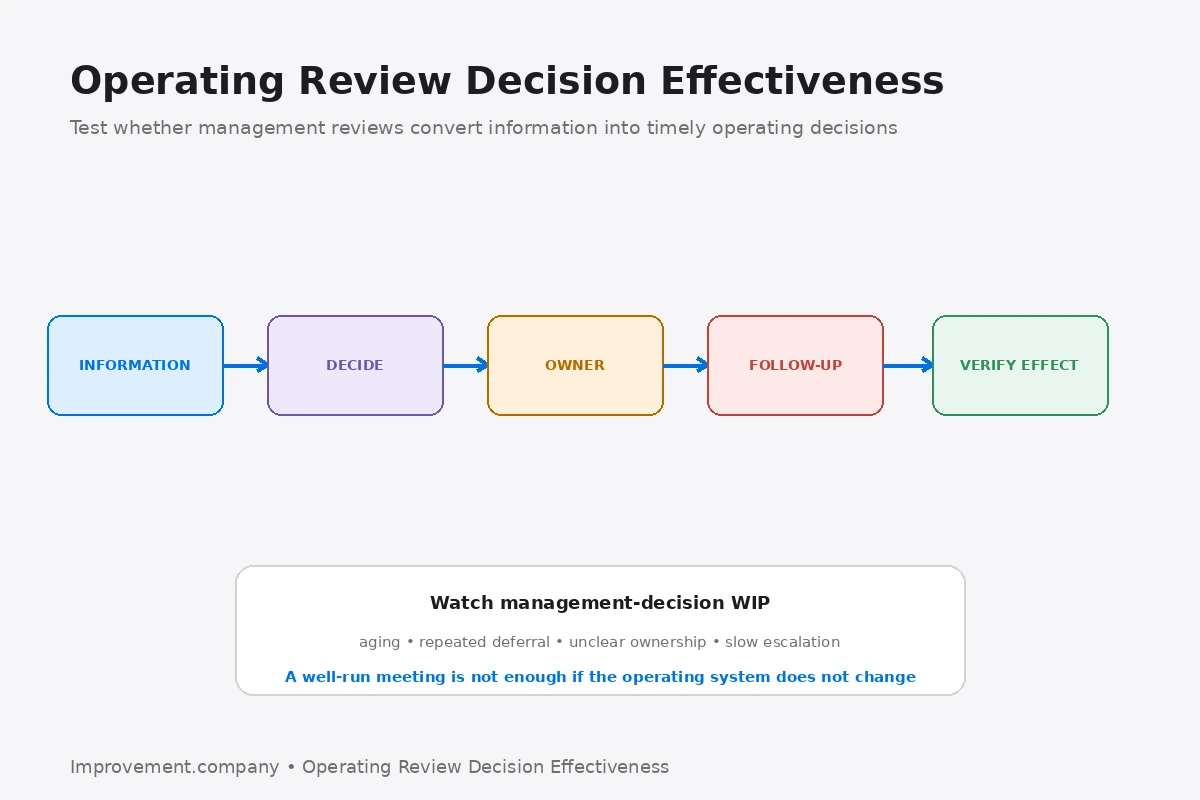
Operating Review Decision Effectiveness examines whether formal management reviews are producing decisions that improve or protect process performance.
The purpose is not to measure meeting attendance.
The purpose is to test whether the review system converts information into useful decisions and follow-through.
Start with the review purpose
Operating Review System helps establish how performance information, decisions, and escalation move through management cadence.
Each review should have a clear role such as:
- monitor performance;
- resolve cross-functional issues;
- allocate resources;
- escalate risk;
- confirm strategy execution.
If the purpose is unclear, decisions tend to drift between meetings.
Review decision yield
Ask how many meaningful issues resulted in:
- a decision;
- an assigned owner;
- a defined next action;
- a clear escalation.
Do not reward a meeting simply because many topics were discussed.
Review decision timing
A useful decision must arrive before the operating window closes.
Process Decision Escalation Review helps identify authority and routing bottlenecks that slow process decisions.
Repeated deferral to the next meeting may indicate weak decision rights or poor preparation.
Review information quality
Leaders need enough evidence to decide.
Check whether the review receives:
- current measures;
- risk information;
- root-cause evidence where relevant;
- clear alternatives.
Poor information creates either delay or intuition-driven decisions.
Review ownership
Every decision requiring follow-up should have one accountable owner.
Process Decision Log helps preserve significant decisions, authority, assumptions, and expected effects.
Important decisions should not disappear into meeting minutes.
Review follow-through
Ask whether previous decisions were:
- executed;
- blocked;
- escalated;
- verified.
A review system that keeps making new decisions while old decisions remain unresolved creates administrative WIP.
Track a small number of open management decisions across review cycles. Aging, repeated deferral, or unclear ownership often reveals more about review effectiveness than the number of agenda items completed.
Review operating effect
Process Performance Management helps connect measures with process ownership and review.
For selected decisions, compare the expected effect with what happened.
Common mistakes
Measuring meeting compliance instead of decision effectiveness, discussing too many topics, deferring decisions repeatedly, accepting weak evidence, assigning actions to groups, failing to review prior decisions, and closing actions without checking operating effect are common mistakes.
Practical sequence
- confirm the review purpose.
- identify significant decisions.
- review decision timing.
- review evidence quality.
- review authority fit.
- assign one owner.
- define expected effect.
- follow up prior decisions.
- verify selected outcomes.
- improve the review design where decisions stall.
The practical lesson
Operating reviews create value when they convert information into timely, owned, evidence-based decisions.
A well-run meeting is not enough if the operating system does not change afterward.