
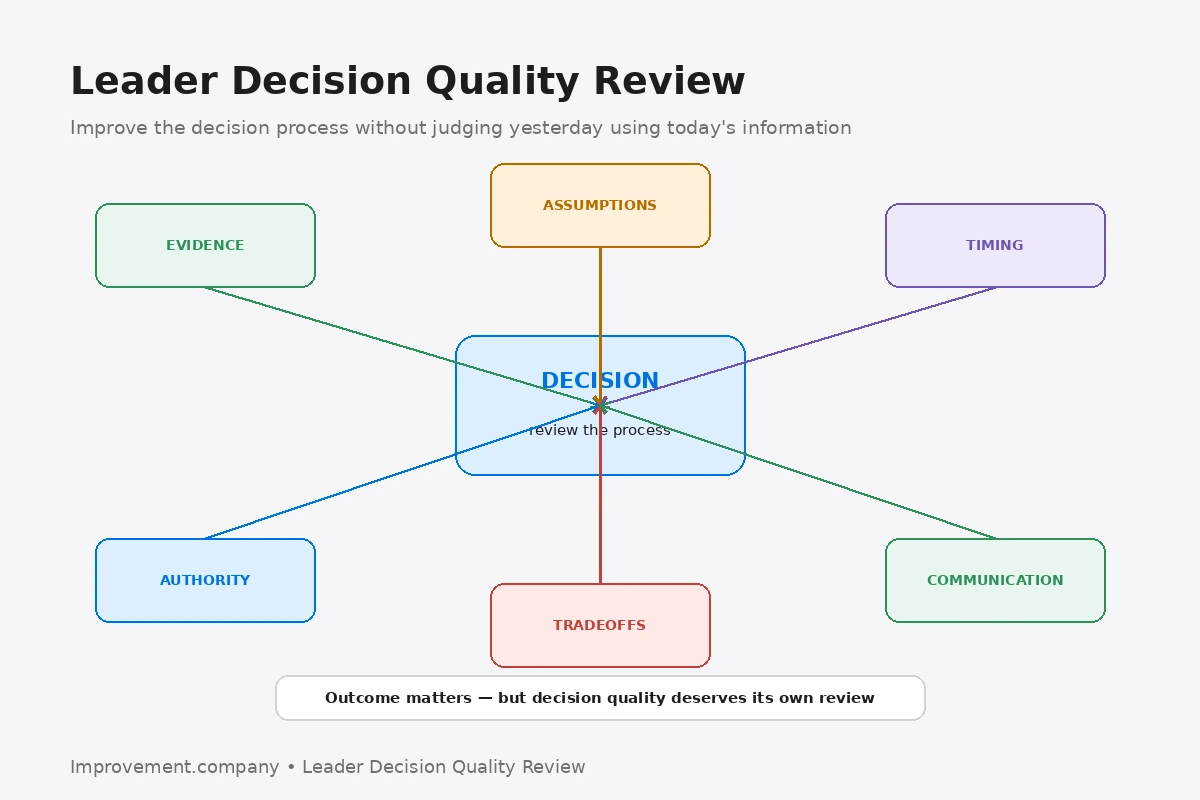
A Leader Decision Quality Review is a structured reflection on significant management decisions after enough evidence exists to judge the decision process and result.
The purpose is not to criticize a leader for every unfavorable outcome.
A good decision can still produce a poor result when uncertainty is real.
The purpose is to improve how decisions are made.
Select meaningful decisions
Review decisions with material consequences such as:
- resource allocation;
- production priority;
- risk acceptance;
- escalation response;
- process change.
Decision Rights in Improvement Work helps clarify who can decide, approve, recommend, or escalate.
Review the evidence available
Ask what information existed at the decision point.
Process Decision Log helps preserve the evidence, authority, assumptions, and expected effects behind significant process decisions.
Avoid judging the decision using information that became available only later.
Review assumptions
Important decisions often depend on assumptions.
Examples include:
- demand will remain stable;
- a repair will last;
- supplier delivery will recover;
- staffing will be available.
Ask whether the assumptions were explicit and reasonable.
Review timing
A technically correct decision made too late may still be ineffective.
Escalation Response Time helps measure how quickly useful support or a decision reaches the operating team.
Consider whether the leader waited for unnecessary certainty or acted before enough evidence existed.
Review tradeoffs
Most important decisions have competing effects.
Examples include:
- output versus maintenance risk;
- speed versus quality protection;
- local efficiency versus system throughput.
Risk-Based Thinking helps make consequence and likelihood visible when tradeoffs involve uncertainty.
Review communication
A good decision can fail if people do not understand:
- what changed;
- why it changed;
- who owns the next action;
- when the decision will be reviewed.
Review the result
Compare the expected effect with what happened.
Do not confuse outcome review with decision-quality review.
A poor outcome should trigger learning, but the review should still ask whether the decision process itself was sound.
Common mistakes
Reviewing only failed decisions, judging old decisions with new information, ignoring timing, treating authority as proof of correctness, overlooking assumptions, focusing only on outcome, and turning the review into blame rather than management-system learning are common mistakes.
Practical sequence
- select a significant decision.
- reconstruct the information available at the time.
- review decision authority.
- review assumptions.
- review timing.
- review tradeoffs.
- review communication.
- compare expected and actual effects.
- identify a decision-process lesson.
- incorporate the lesson into future leader routines.
The practical lesson
A Leader Decision Quality Review improves management judgment through evidence.
The organization learns faster when leaders examine not only what happened, but how important choices were made.