
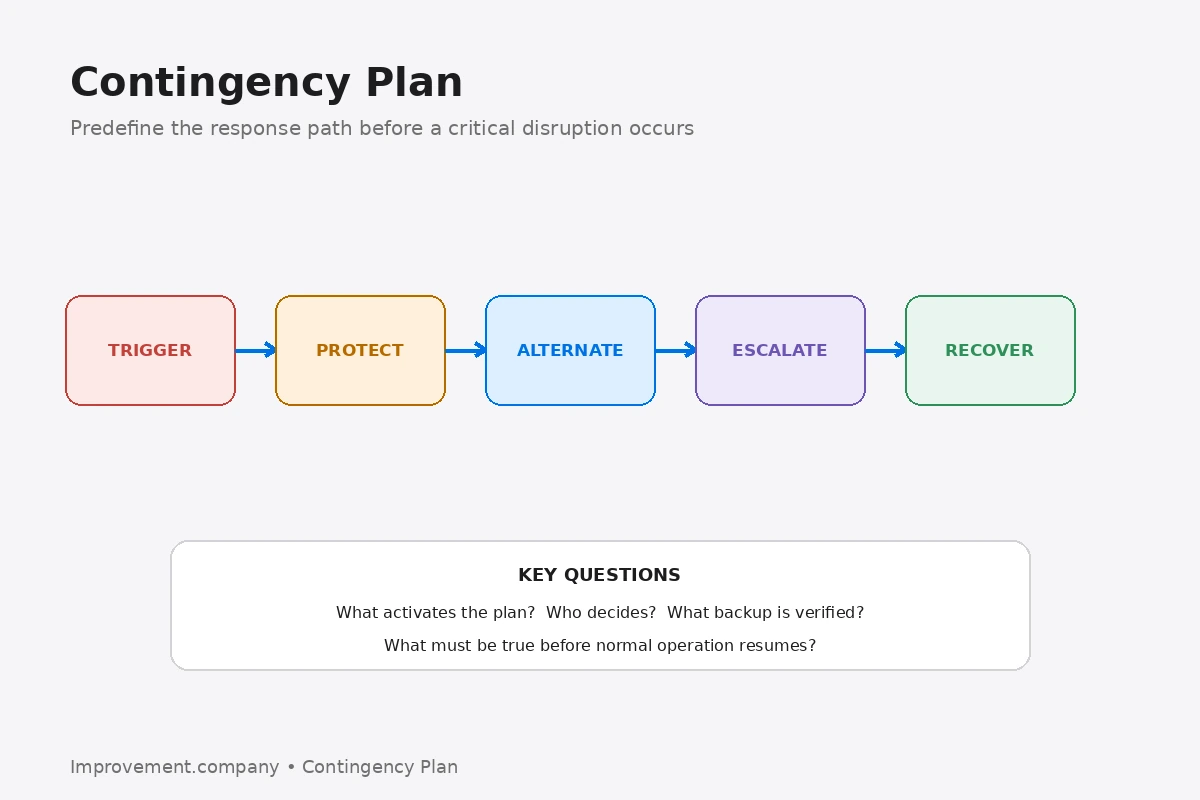
A Contingency Plan defines how the organization will respond when a critical process, resource, or dependency becomes unavailable.
Examples include critical equipment failure, supplier interruption, utility loss, system outage, and labor shortage.
The objective is to make important decisions before the disruption occurs.
Start with critical scenarios
Use risk-based thinking to identify events that could significantly affect safety, customer delivery, quality, compliance, or continuity.
Risk-Based Thinking helps prioritize scenarios based on consequence and likelihood.
Do not create detailed contingency plans for every imaginable event.
Define the trigger
The plan should state when it becomes active.
Examples include a utility outage longer than 15 minutes, critical machine unavailable, supplier confirms a missed shipment, or a system inaccessible at shift start.
A trigger removes ambiguity during a disruption.
Define immediate protection
The first response may include safe shutdown, quality containment, customer notification, inventory protection, or alternate routing.
The priority should be risk control before production recovery.
Define alternate methods
Possible alternatives include backup equipment, alternate supplier, manual process, secondary site, or temporary schedule change.
Alternatives should be pre-assessed where practical.
A contingency plan is weak if the backup has never been verified.
Assign roles and authority
The plan should identify the response leader, technical support, communication owner, and decision authority.
Process Governance helps clarify ownership and authority for important operating decisions.
Define escalation and communication
Escalation Management helps structure the request for decisions and support.
The contingency plan should define who must be informed and when.
External communication may include customer, supplier, regulator, or corporate leadership.
Define recovery criteria
The plan should state what must be true before normal operation resumes.
Examples include equipment verified, system stable, quality checks complete, and backlog recovery plan approved.
Recovery should be controlled, not assumed.
Test the plan
A plan that has never been exercised may contain outdated contacts, unavailable backup resources, unrealistic timing, and unclear roles.
Periodic testing can reveal these weaknesses before a real disruption.
Common mistakes
Planning for every possible event, defining no activation trigger, focusing only on production recovery, relying on unverified backup options, assigning no decision authority, leaving outdated contact information, and returning to normal operation without defined recovery criteria are common mistakes.
Practical sequence
- identify critical disruption scenarios.
- assess business risk.
- define activation triggers.
- define immediate protection.
- define alternate methods.
- assign roles and authority.
- define communication and escalation.
- define recovery criteria.
- test the plan.
- update it after exercises and real events.
The practical lesson
A Contingency Plan reduces decision delay during disruption. The best time to decide how to respond to a critical failure is before the failure happens.