
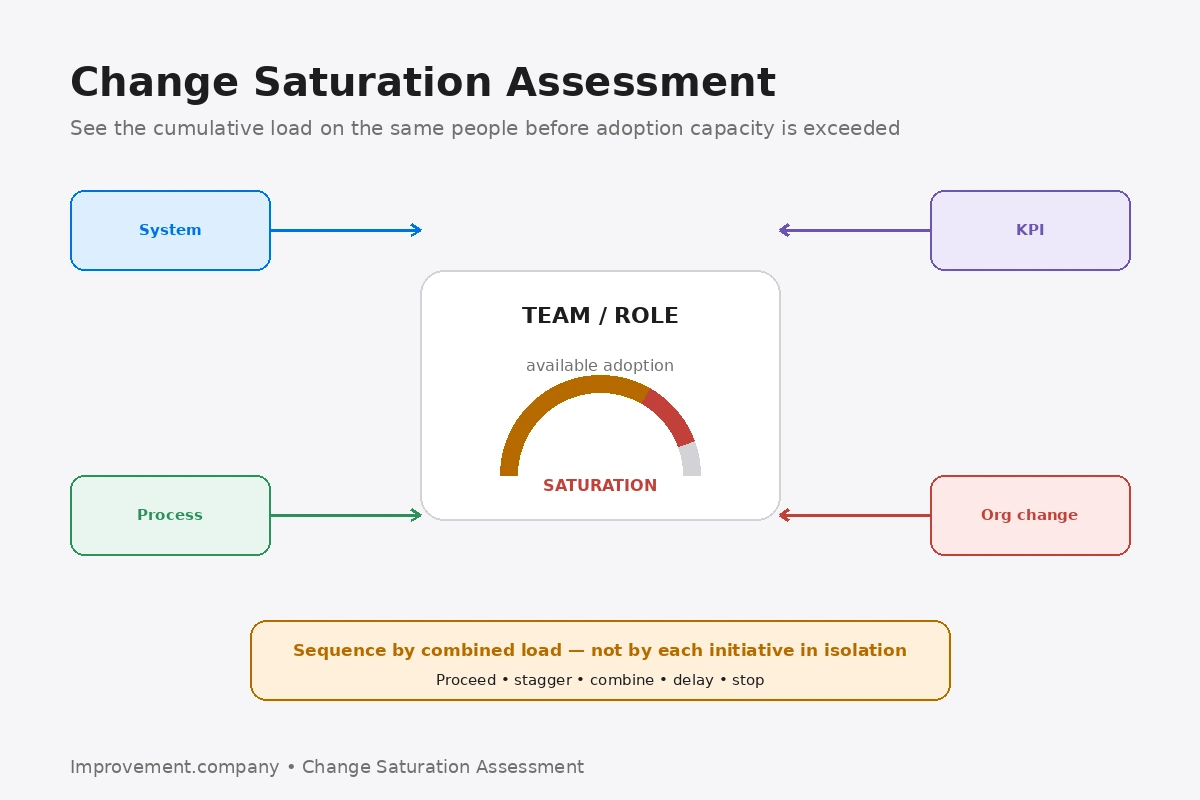
A Change Saturation Assessment evaluates how many changes are affecting the same people, teams, or processes at the same time.
One initiative may be manageable.
Five overlapping initiatives may create:
- confusion;
- competing priorities;
- training overload;
- weak adoption.
The objective is not to slow all change.
The objective is to understand whether local capacity can absorb the combined demand.
Identify affected groups
Start with the teams, roles, or locations receiving change.
Change Impact Assessment helps identify how roles, systems, workflows, and behaviors are changing for affected groups.
The saturation assessment adds the question:
What other changes are hitting these same people at the same time?
Map concurrent changes
List active changes by group.
Examples include:
- new system;
- new standard work;
- organizational change;
- new KPI process;
- product launch.
The combined workload is often invisible when each initiative is managed separately.
Assess adoption effort
Not all changes consume the same capacity.
Consider:
- training time;
- behavior change;
- process redesign;
- leadership attention;
- troubleshooting.
Change Readiness Assessment helps evaluate whether people and systems are prepared for a specific change.
Saturation looks across multiple changes at once.
Look for conflicting behaviors
Two changes may ask employees to behave differently in the same process.
Examples include:
- one initiative decentralizes decisions while another adds approvals;
- one system removes a form while another still requires it.
These conflicts should be resolved before launch.
Review timing peaks
Change demand may cluster around:
- quarter-end;
- shutdown;
- system launch;
- peak production period.
Workload Leveling provides useful thinking for distributing demand more evenly across available capacity.
Some change activity can be resequenced without reducing strategic value.
Review leadership capacity
Leaders must reinforce change while also running daily operations.
Leader Standard Work helps embed follow-up and process confirmation into normal management routines.
If leaders are supporting too many simultaneous changes, reinforcement quality may collapse.
Decide what to sequence
Possible decisions include:
- proceed;
- stagger;
- combine;
- delay;
- stop.
The decision should consider risk, urgency, dependencies, and local capacity.
Monitor actual adoption
Change Adoption Review helps verify whether the new behavior is becoming normal work.
Weak adoption across several initiatives may indicate saturation rather than resistance to any one change.
Common mistakes
Assessing each initiative independently, counting initiatives without considering effort, ignoring conflicting behaviors, launching major changes during peak workload without planning, assuming employees will absorb unlimited training, and labeling weak adoption as resistance without checking saturation are common mistakes.
Practical sequence
- identify affected groups.
- map concurrent changes.
- estimate adoption effort.
- identify timing overlap.
- identify conflicting behaviors.
- assess leader capacity.
- prioritize by risk and value.
- sequence or combine work.
- monitor adoption.
- reassess saturation as new initiatives enter.
The practical lesson
A Change Saturation Assessment makes cumulative change demand visible.
Organizations improve adoption when they manage the total load on people, not only the plan for each initiative.